

Consent Comes Before Power: Why AI Infrastructure Keeps Missing Its Dates
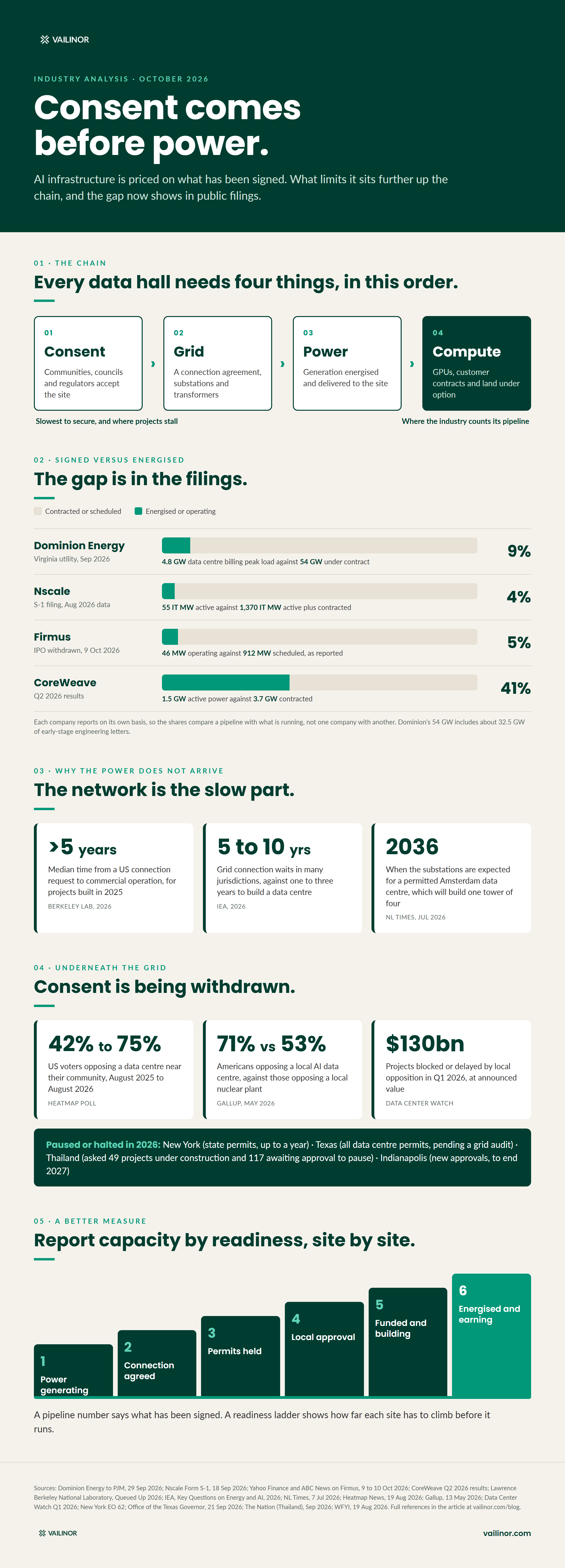
The AI infrastructure industry measures the wrong end of its own supply chain. Developers, neoclouds and the investors behind them count what has been signed: GPUs on order, customer contracts, land under option, megawatts "contracted." Before a data hall can run it needs power. Before power, it needs a grid connection. Before a grid connection, it needs permission from regulators, utilities and the people who live near the site. In our view each of those links is harder to secure than the one after it, and the industry has been pricing the last one.
The distance between signed capacity and energised capacity is now wide enough to read in public filings, and in the past month at least one large IPO was pulled after investors questioned it.
The gap is in the filings
The clearest single number comes from the largest data centre market in the world. In a forecast presented to PJM on 29 September 2026, Dominion Energy reported approximately 54 GW of data centre capacity under contract in its service territory, against a data centre billing peak load of 4.8 GW in August 2026.1 The utility does not take its own contract book at face value. It leaves 59 per cent of its early-stage engineering letters out of the forecast and assumes customers ramp over five years to 63 per cent utilisation. About 21.4 GW of the 54 GW sits in firmer construction letters and service agreements; the rest is engineering letters.
The same pattern shows up company by company. Nscale's S-1, filed on 18 September 2026, defines active capacity as IT megawatts "online and revenue generating." By that definition Nscale had 55 IT MW active at the end of August, against 1,370 IT MW active plus contracted, about 4 per cent.2 Its planned Loughton campus in England has been reported as delayed because the grid connection it needs will not be ready for the planned 2027 opening.3
Firmus Technologies withdrew its ASX listing, which had sought to raise about A$7.1 billion, on 9 October 2026.45 The board said proceeding was "not in the best interests of the company and its shareholders," and the company also pointed to market volatility.56 Investors raised several objections, including the valuation, future debt needs and the detail in the prospectus. One fund manager, quoted by the Sydney Morning Herald, put the capacity point in a sentence: the company had "46 megawatts operating out of 912 megawatts scheduled."5 Earlier in the year Firmus and CDC had ended Project Southgate, a plan for up to 1.6 GW of AI capacity by 2028, after about 42 MW had been deployed.7
The largest neoclouds carry a gap too. CoreWeave, one of the largest neoclouds, reported 1.5 GW of active power against roughly 3.7 GW contracted at the end of June 2026.8 Across the market, Sightline Climate counted at least 16 GW of data centre capacity slated for 2026, with about 5 GW under construction, and expects 30 to 50 per cent of this year's large projects to slip.9
None of this implies bad faith. A contract is a commitment to build, and building takes time. In our view the ratio between contracted and energised capacity has become the most important number in the sector, and it is rarely the number in the headline.
Why the power does not arrive
In most markets the scarce part is the network more than the generation: substations, transformers, transmission lines and the queue to connect to them.
In the United States, Berkeley Lab's 2026 study of generation and storage interconnection found the median time from a connection request to commercial operation was over five years for projects built in 2025, and only 13 per cent of the capacity that requested connection between 2000 and 2020 had been built by the end of 2025.10 The International Energy Agency puts grid connection waits at "as long as five to ten years in many jurisdictions," with transformers taking two to three years and gas turbines around five.11 A data centre itself takes one to three years to build, and the IEA counts more than 2,500 GW of renewable, large-load and storage projects stalled in grid queues worldwide.12
Europe shows the same arithmetic. In Great Britain, contracted demand connection offers rose from 41 GW to 125 GW between November 2024 and June 2025, with data centres accounting for at least 80 GW. Ofgem has proposed a commitment fee of £237,500 to £712,500 per megawatt for data centre projects, refunded "when the project reaches energisation."13 The regulator has chosen energisation as the milestone that counts. In Amsterdam, Equinix received a permit for a four-tower data centre in July 2026 and plans to build one tower, because the substations it needs are expected in 2036.14
Where the grid does connect large loads, it struggles to keep up. PJM's capacity auction for 2027/28 recorded a 5,250 MW increase in forecast load, "largely due to additional Large Loads," against 774 MW of new generation and uprates. The auction cleared at its price cap and fell 6,517 MW short of the reliability requirement.15
Microsoft has said this on the record. In October 2025 Microsoft's CFO, Amy Hood, told investors the company was not short of GPUs; it was "short the space or the power" to put them in.16
Networks are slow because they are the hardest part of the energy system to approve. A power plant sits on one parcel. A transmission line crosses hundreds of them, and a substation lands in someone's neighbourhood. That takes the question one step further back.
Underneath the grid sits consent
Public acceptance of data centres has fallen sharply in the past year. Heatmap's polling, run with identical wording each time, found opposition to a data centre near the respondent's community rose from about 42 per cent in August 2025 to 75 per cent in August 2026, while strong support fell from 13 per cent to 4 per cent.17 Gallup found in March 2026 that 71 per cent of Americans oppose an AI data centre in their area, more than the 53 per cent who oppose a nearby nuclear plant.18 In Virginia, the share of voters comfortable with a new data centre in their community fell from 69 per cent in 2023 to 35 per cent in 2026.19
That sentiment is now turning into decisions. Data Center Watch counted at least 75 projects worth about $130 billion blocked or delayed by local opposition in the first quarter of 2026, and at least 45 worth about $68 billion in the second.20 Those totals combine blocked and delayed projects at their announced value, so they overstate lost investment, and the second-quarter count was lower than the first, but the scale is large. The 2,000-acre Prince William Digital Gateway in Virginia was terminated in July 2026 after the courts voided its rezoning.21 Indianapolis paused new data centre approvals until at least the end of 2027.22 Georgia voters removed two utility regulators by roughly 25 points in November 2025, in an election where power bills and data centre load were central issues.23
States have followed. New York paused environmental permits for new hyperscale data centres for up to a year in July 2026.24 In September the governor of Texas, a state that has offered the industry generous incentives, directed the state environmental regulator to "halt all permits sought by data centers" until the grid operator completes an audit.25 The same month, a national data centre board in Thailand resolved to pause 49 projects under construction and 117 awaiting approval while it writes new rules. Thailand's planning agency later said the government could not order builders to stop or delay construction, which in practice made the pause a request.26
These are different countries, parties and political systems, and they reached similar decisions within the same twelve months.
Why communities are withdrawing it
Large energy infrastructure has long asked its host communities to accept costs in return for something. Data centres bring a tax base, and in some places it is large: data centres paid Loudoun County, Virginia, $733 million, according to a 2024 summary by Virginia's legislative auditor.27 What they bring in employment is thin relative to the capital involved. Meta's Hyperion campus in Louisiana is a commitment of more than $50 billion for 5 GW of IT capacity, with about 1,000 operational jobs.28 Virginia's legislative auditor found a typical facility employs about 50 people, roughly half of them contractors, and that four-fifths of the industry's jobs in the state are in construction.29
Power stations were never large employers either. Iowa's nine coal plants together employed 613 workers in 2020.30 What has changed is the list of things a community is being asked to accept relative to the payroll.
Electricity bills come first. PJM's independent market monitor attributes $29.4 billion, or 46.2 per cent, of capacity charges across the last four auctions to data centre load, and estimates that data centre load added $11.11 per MWh to the all-in wholesale cost of power in the first half of 2026.31 Those are the monitor's counterfactuals, not a bill audit. In Gallup's survey, about half of opponents cited resource use such as water and energy.18
The second item is new. Pew found in 2025 that 64 per cent of American adults expect AI to lead to fewer jobs in the United States over the next twenty years.32 Communities are being asked to host, with their own power and water, the machinery of a technology most Americans expect to cost jobs. That is a different request from the one a town weighed when the infrastructure in question was a power station, and in our view it is part of why the polling has moved so quickly.
The state's answer is permission
Governments that want the build-out are responding by moving the decision away from local authorities. In January 2026 the UK government brought data centres in England into the nationally significant infrastructure regime, so a developer can ask for a minister to decide in place of the local council.33 Its AI Growth Zones are pitched as "slashing approval times from years to months."34 Ministers have already overturned council refusals of green-belt data centres at Iver and Abbots Langley.3536 In the United States, Executive Order 14318 fast-tracks federal permitting for data centre projects above 100 MW.37
These routes can produce a permit, but a permit granted over a council's refusal leaves the local objection where it was. A data centre and the generation behind it are long-lived assets, and their economics depend on tariffs, water rights, tax treatment and connection rules that state and local politics can revisit at any point in that life. Texas has just demonstrated how quickly that can happen. An asset approved over local objection carries that political exposure for as long as it operates.
The override routes are also partial. The UK route is opt-in and was still waiting on its national policy statement early in 2026,38 and the US order does not touch local zoning.
The workaround runs into the same wall
Many developers have responded to slow grid connections by building their own power. The IEA reports that US developers, "constrained by slow grid connections," are pushing ahead with on-site gas generation, which needs 30 to 70 per cent overbuild to match grid reliability.11 That route has its own queue. GE Vernova's gas turbine backlog and reservations reached 116 GW in mid-2026, and the company is taking reservations for 2031 deliveries.39 Cleanview counts 59 US data centres planning their own power plants, about 90 GW in total, of which about 2 GW is operating.40
Consent catches up with this route too, because an on-site power plant is a power plant. In September 2026 New Jersey fined DataOne, the operator of a Vineland data centre campus, $1.07 million, saying it had installed and run 62 natural gas engines without air permits.41 Mississippi permitted 41 turbines for xAI's Southaven site to replace 27 temporary units that critics said were running without permits; the state regulator had treated them as mobile units that did not need one.42 Legal analysis of the Texas permit halt says it is unclear whether it reaches islanded behind-the-meter projects, which is itself a sign of where the risk now sits.25
What the counter-case gets right
Power is not the only constraint. The IEA expects a shortage of high-bandwidth memory to last through at least the end of 2027,11 and CoreWeave's chief executive said in May 2026 that "the limiting factor isn't just power."43 Memory, labour and equipment are bottlenecks too. Memory and equipment are supply-chain constraints that new factories can relieve in a few years, and labour responds to wages and training. Network and consent constraints run on permitting and election cycles.
Queue totals overstate demand. Many requests are speculative, which is why Ofgem is proposing a fee and why Dominion discounts its own contract book. Load growth has also tended to lower retail electricity prices in recent years, according to Berkeley Lab and Brattle,44 so the bill argument is a forecast of where costs are heading, and the record so far is mixed. Some communities still want these projects: Maine's governor vetoed a statewide moratorium in 2026 to protect a $550 million project at a closed paper mill.45
Each of these points leads to the same place. Demand for compute is persistent, and when a site meets resistance the demand goes looking for capacity that can be energised with less friction.
Smaller sites need consent too
One response to campus-scale opposition is to go smaller and spread out. Distribution shrinks each request, which helps, but it multiplies the number of requests. Twenty sites means twenty planning processes, twenty local authorities and twenty chances for an organised objection, and an objection that works in one county can be reused in the next. Anyone who has developed infrastructure will raise this within the first minute of a pitch.
Spreading out changes the political arithmetic only when each site already has what a new campus has to ask for: power that is already generated, water that is already on site, and a land use the surrounding community accepted years ago. In our view the distinction that matters is between sites that need new consent and sites that build on consent already given. Discontent is also likely to grow as the effect of AI on employment becomes visible, so the consent a site starts with has to be durable enough to survive that.
Report capacity by readiness
If the constraint runs from consent to grid to power to compute, the industry should report capacity by where it sits on that chain. A credible disclosure would show, for every site: whether power is already generating or has to be built; whether a connection agreement exists and its date; which permits are held; the state of local approval; whether the site is funded and under construction; and how much capacity is energised and earning revenue. Nscale's S-1 already separates active from contracted capacity, and the investors who read "46 megawatts operating out of 912" were doing this analysis informally.
Investors who ask for this breakdown will see the risk in a pipeline earlier, and developers who publish it give lenders and customers something they can underwrite site by site.
Where Vailinor fits
Vailinor is developing AI compute capacity at operating biomass power plants in Thailand, supplied behind the plant's meter. We started with the first rung. Our first site is with Kaona Power Supply, a plant whose first generating unit began commercial operation in January 2008, according to Thailand's Energy Regulatory Commission registry.46 The plants we work with already generate power, already have water on site, already run a fuel supply chain, already employ local staff and have years of history with the communities around them. Adding a data hall on land beside a plant that has operated for years is a smaller request of a community than a new campus on open land, and it gives that plant a long-term buyer for its power on site.
We checked that in person. On our trip to Ubon Ratchathani we met the community around the plant and the local administration, and both support the project. That support grew out of years of the plant operating as a neighbour, and it is the kind of consent the rest of this article describes the industry running short of.
This does not exempt us from the questions in this article. Thailand asked data centre projects to pause in September while it writes new rules,26 and the country's framework for on-site private power supply is still being finalised. Our first site is targeted for service in late 2027, subject to funding. We expect to be measured on the same ladder we are proposing, and we intend to report our sites against it.
References
- Dominion Energy, "LSE 20-Year Data Center Forecast," PJM Load Analysis Subcommittee, 29 Sep 2026. https://www.pjm.com/-/media/DotCom/committees-groups/subcommittees/las/2026/20260929/20260929-item-5ai---dominion_energy.pdf
- Nscale Ltd, Form S-1, US SEC, 18 Sep 2026. https://www.sec.gov/Archives/edgar/data/2110365/000119312526395475/ck0002110365-20260918.htm
- Data Centre Review, "Nscale's £2bn Essex data centre hit by grid delays," 14 Jul 2026, summarizing The Telegraph, 13 Jul 2026. https://datacentrereview.com/2026/07/nscales-2bn-essex-data-centre-hit-by-grid-delays/
- ABC News, "How Firmus, the biggest IPO in three decades, fell over," 10 Oct 2026. https://www.abc.net.au/news/2026-10-10/how-firmus-the-biggest-ipo-in-three-decades-fell-over/107247100
- Yahoo Finance, "Firmus withdraws $7.1 billion IPO," 9 Oct 2026 (quoting the board statement and, via the Sydney Morning Herald, Minotaur Capital's Armina Rosenberg). https://finance.yahoo.com/technology/ai/articles/firmus-withdraws-7-1-billion-151554787.html
- Forbes Australia, "Explaining Firmus and the $44 billion IPO collapse," Oct 2026. https://www.forbes.com.au/news/investing/explaining-firmus-and-44-billion-ipo-collapse/
- W.Media, "Firmus and CDC end Project Southgate partnership after 42MW rollout," 6 Oct 2026. https://w.media/firmus-and-cdc-end-project-southgate-partnership-after-42mw-rollout/
- CoreWeave, "CoreWeave Reports Strong Second Quarter 2026 Results," 11 Aug 2026. https://investors.coreweave.com/news/news-details/2026/CoreWeave-Reports-Strong-Second-Quarter-2026-Results/default.aspx
- Latitude Media, "Up to half of the world's data centers may be delayed this year," 24 Feb 2026 (Sightline Climate data). https://www.latitudemedia.com/news/up-to-half-of-the-worlds-data-centers-may-be-delayed-this-year/
- Lawrence Berkeley National Laboratory, "Queued Up: 2026 Edition," May 2026. https://eta-publications.lbl.gov/publications/queued-2026-edition-characteristics
- International Energy Agency, "Key Questions on Energy and AI," April 2026. https://www.iea.org/reports/key-questions-on-energy-and-ai
- International Energy Agency, "Electricity 2026: Grids," 2026. https://www.iea.org/reports/electricity-2026/grids
- Ofgem, "Ofgem acts to free up grid capacity by tackling speculative data centre projects," 29 Jul 2026. https://www.ofgem.gov.uk/press-release/ofgem-acts-free-grid-capacity-tackling-speculative-data-centre-projects
- NL Times, "Construction permit granted for massive data center in Amsterdam Zuidoost," 7 Jul 2026. https://nltimes.nl/2026/07/07/construction-permit-granted-massive-data-center-amsterdam-zuidoost
- PJM Interconnection, "2027/2028 Base Residual Auction Report," 17 Dec 2025. https://www.pjm.com/-/media/DotCom/markets-ops/rpm/rpm-auction-info/2027-2028/2027-2028-bra-report.pdf
- Microsoft FY2026 Q1 earnings call, 29 Oct 2025, transcript. https://www.fool.com/earnings/call-transcripts/2025/10/29/microsoft-msft-q1-2026-earnings-call-transcript/
- Heatmap News, data center opposition poll, 19 Aug 2026. https://heatmap.news/daily/data-center-opposition-poll-collapse
- Gallup, "Americans Oppose Data Centers in Their Area," 13 May 2026. https://news.gallup.com/poll/709772/americans-oppose-data-centers-area.aspx
- Washington Post-Schar School poll of Virginia voters, 15 Apr 2026, as syndicated by The Spokesman-Review. https://www.spokesman.com/stories/2026/apr/15/in-this-us-hot-spot-for-data-centers-voters-have-t/
- Data Center Watch, Q1 2026 and Q2 2026 reports. https://www.datacenterwatch.org/q1-2026 and https://www.datacenterwatch.org/q2-2026
- WTOP, "Digital Gateway data center project dies after final developer withdraws appeal," Jul 2026. https://wtop.com/prince-william-county/2026/07/digital-gateway-data-center-project-dies-after-final-developer-withdraws-appeal/
- WFYI, "New data centers temporarily banned in Marion County," 19 Aug 2026. https://www.wfyi.org/wfyi-news/2026-08-19/new-data-centers-temporarily-banned-in-marion-county
- Boston Globe, "The politics of data centers and electric bills," 30 Nov 2025. https://www.bostonglobe.com/2025/11/30/business/politics-data-centers-electric-bills
- Inside Climate News, "New York's first data center moratorium," 14 Jul 2026. https://insideclimatenews.org/news/14072026/new-york-first-data-center-moratorium/
- Office of the Texas Governor, "Governor Abbott Directs TCEQ To Halt Data Center Permits," 21 Sep 2026. https://gov.texas.gov/news/post/governor-abbott-directs-tceq-to-halt-data-center-permits ; on scope, Troutman Pepper Locke analysis. https://www.troutman.com/insights/governor-abbott-directs-tceq-to-halt-all-data-center-permits-pending-ercot-twdb-audits/
- The Nation (Thailand), 5 Sep 2026 and 15 Sep 2026. https://www.nationthailand.com/business/tech/40070670 and https://www.nationthailand.com/business/tech/40071042
- Joint Legislative Audit and Review Commission (Virginia), report summary, Dec 2024. https://pwcva.gov/assets/2024-12/JLARC%20Report%20Summary_12-16-2024.pdf
- Louisiana Economic Development, "Meta commits more than $50 billion for North Louisiana project," 13 Jul 2026. https://www.opportunitylouisiana.gov/news/meta-commits-more-than-50-billion-for-north-louisiana-project-becoming-one-of-the-largest-data-centers-in-history
- George Mason University CARE, STEP Brief 5, Sep 2026, citing JLARC Report 598. https://care.gmu.edu/wp-content/uploads/STEP_Brief_05_Data_Centers_2026-09-03.pdf
- Iowa State University Extension for the Iowa Environmental Council, economic impacts of Iowa coal plants, executive summary. https://npr.brightspotcdn.com/0a/18/dad3e237444eaf701f0fa00c88b4/100721-economic-fiscal-social-impacts-of-coal-power-plants-exec-summary.pdf
- Monitoring Analytics (PJM Independent Market Monitor), Members Committee presentation, 27 Jul 2026. https://www.pjm.com/-/media/DotCom/committees-groups/committees/mc/2026/20260727-web/item-02---marketing-monitoring-report---presentation.pdf
- Pew Research Center, "How the U.S. Public and AI Experts View Artificial Intelligence," 3 Apr 2025. https://www.pewresearch.org/internet/2025/04/03/public-and-expert-predictions-for-ais-next-20-years/
- The Infrastructure Planning (Business or Commercial Projects) (Amendment) Regulations 2026, SI 2026/13. https://www.legislation.gov.uk/uksi/2026/13/made
- UK Government, AI Growth Zones announcement, 13 Nov 2025. https://www.gov.uk/government/news/ai-growth-zones-to-create-thousands-of-jobs-and-unlock-up-to-100-billion-in-investment-as-new-site-confirmed-for-north-wales
- Building Design, Iver data centre approved after ministerial intervention, Dec 2024. https://www.bdonline.co.uk/news/genslers-controversial-data-centre-scheme-gets-green-light-after-rayner-intervention/5133255.article
- Baxtel, reprinting DatacenterDynamics, "Angela Rayner overturns decision to block data center planned for Hertfordshire," 15 May 2025. https://baxtel.com/news/angela-rayner-overturns-decision-to-block-data-center-planned-for-hertfordshire-uk
- The White House, Executive Order 14318, "Accelerating Federal Permitting of Data Center Infrastructure," 23 Jul 2025. https://www.whitehouse.gov/presidential-actions/2025/07/accelerating-federal-permitting-of-data-center-infrastructure/
- Forsters, "Data centres formally brought into the NSIP regime: what developers need to know," 2026. https://www.forsters.co.uk/news-and-views/data-centres-formally-brought-into-the-nsip-regime-what-developers-need-to-know
- GE Vernova, Q2 2026 results (Form 8-K), 22 Jul 2026, https://www.sec.gov/Archives/edgar/data/0001996810/000199681026000147/gevpressrelease2q26.htm ; Utility Dive, 23 Jul 2026, https://www.utilitydive.com/news/ge-vernova-gas-turbine-backlog-climbs-to-116-gw/826039/
- Cleanview, "Behind-the-meter data centers," 2026. https://cleanview.co/reports/behind-the-meter-data-centers
- ROI-NJ, "State fines DataOne $1M for pollution permit violations involving Vineland data center," 23 Sep 2026. https://www.roi-nj.com/2026/09/23/politics/state-fines-dataone-1m-for-pollution-permit-violations-involving-vineland-data-center/
- Mississippi Free Press, Southaven turbine permit, Mar 2026. https://www.mississippifreepress.org/mississippi-permit-board-grants-xais-request-for-41-southaven-gas-turbines-to-power-memphis-data-center/
- CoreWeave Q1 2026 earnings call, 7 May 2026, transcript. https://s205.q4cdn.com/133937190/files/doc_financials/2026/q1/CoreWeave-Inc-CRWV-US-Q1-2026-Earnings-Call-7-May-2026-5_00-PM-ET.pdf
- The Brattle Group, contribution to Berkeley Lab report on US electricity price trends, 17 Oct 2025. https://www.brattle.com/insights-events/publications/brattle-contributes-to-berkeley-lab-report-assessing-recent-trends-in-electricity-prices-across-the-us/
- WBUR, "Maine data center development ban vetoed by Mills," 27 Apr 2026. https://www.wbur.org/news/2026/04/27/maine-data-center-development-ban-vetoed-mills
- Energy Regulatory Commission of Thailand, SPP/VSPP registry (Kaona Power Supply). https://ws.erc.or.th/ERCSPP
Published on vailinor.com by Mark Blashfield, Co-Founder & CEO, Oct 13, 2026.